
Emergency Communications
If you don't prepare, you won't be ready.


At the recent “No Kings 3” event, my partner and I decided to test our Meshtastic radios ability to communicate and to use them to locate each other in real-world conditions. Some of you may know my belief that in the future, we may well find ourselves in situations where the authorities have turned off cell/internet access and we still need to be able to communicate and organize.
In my home town the crowd was extremely dense, and I wondered how it would work as the 900Mhz band that Meshtastic uses is not robust against interference. The downtown area where the event was held is also a Meshtastic desert - I’ve never been able to reach any other mesh nodes from the downtown area, but we should be able to communicate with each other even if we couldn’t get out to the wider mesh.
We used Rak 4631 nodes with little 2dBi stubby antennas. I wore mine on a lanyard around my neck and my partner wore theirs on a wrist lanyard. We used bluetooth on our phones to control the radios but we disabled WiFi and cell service on our phones before traveling to the event, so we simulated an environment where cell and internet were denied. It also made us somewhat less trackable.
What worked well was we were able to reliably communicate with each other via Meshtastic. We didn’t try farther than 800 feet or so, it was very hard to walk around as the sidewalks were wall-to-wall people. We both have our radios set to only broadcast an approximate position +/- 1 mile, except on a private channel that we set up with a private 256-bit AES encryption key. On this channel, we could both send our position to the other and get a precise (which turned out to mean about +/- 10ft) position.
There are definitely some oddities with Meshtastic. Every time I sent a message, my position reverted to the +/- 1 mile accuracy, and I had to re-send my position on the private channel to share my precise location with my partner again. We tried locating each other with the compass functionality in Meshtastic, and it worked pretty well, it gets you within about 10 feet of the other person.
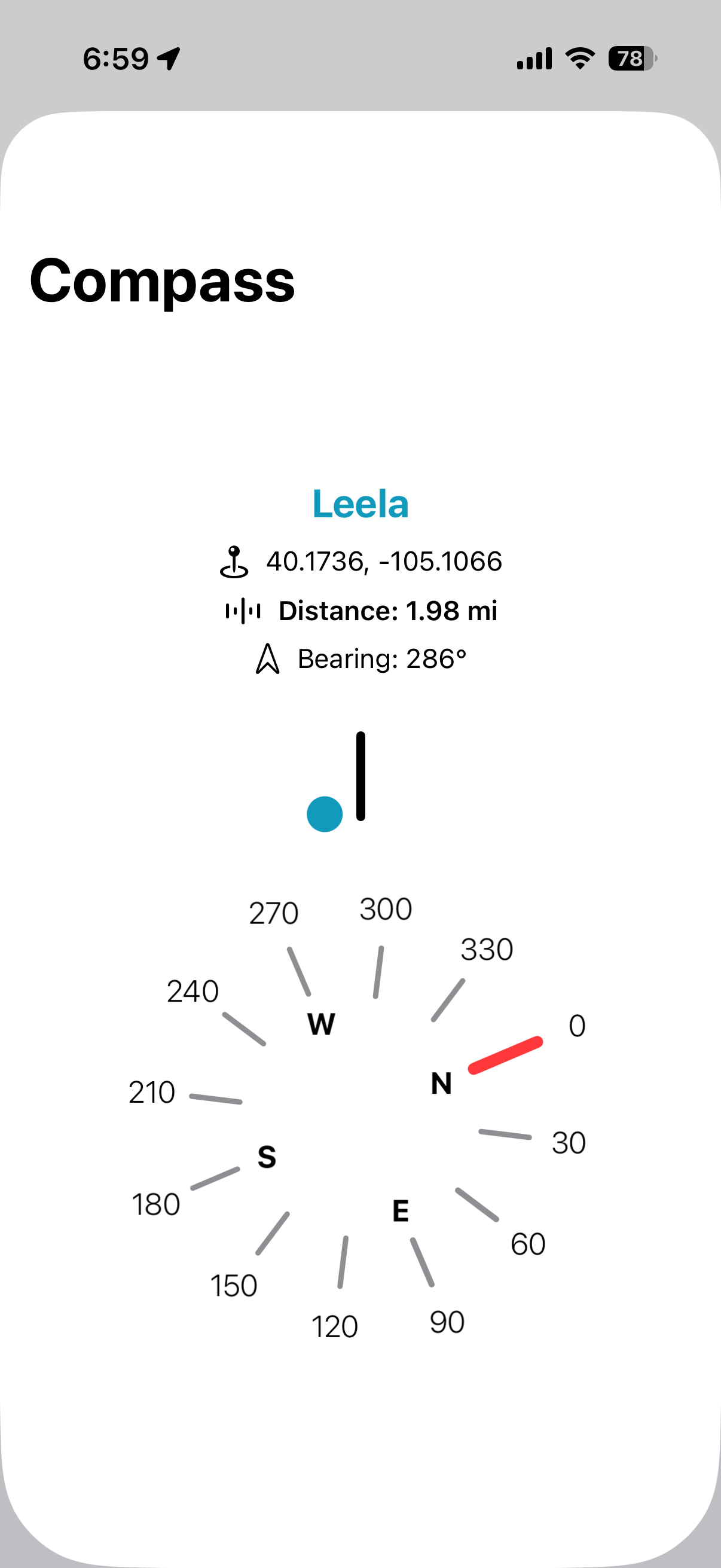
Face north, turn yourself til the blue dot lines up with the black line, and start walking.
There’s also a map interface if you prefer that.
We noticed some slightly different behavior between our two radios. The iOS Meshtastic app has (literally) 27 configuration screens, so we will have to go through them all and carefully configure them identically. Once we do this, I should be able to provide recommended settings.
I also picked up a couple Baofeng UV-5R handheld transceivers (HT) to experiment with. These are analog HAM radio type radios, basically “walkie talkies for grownups”
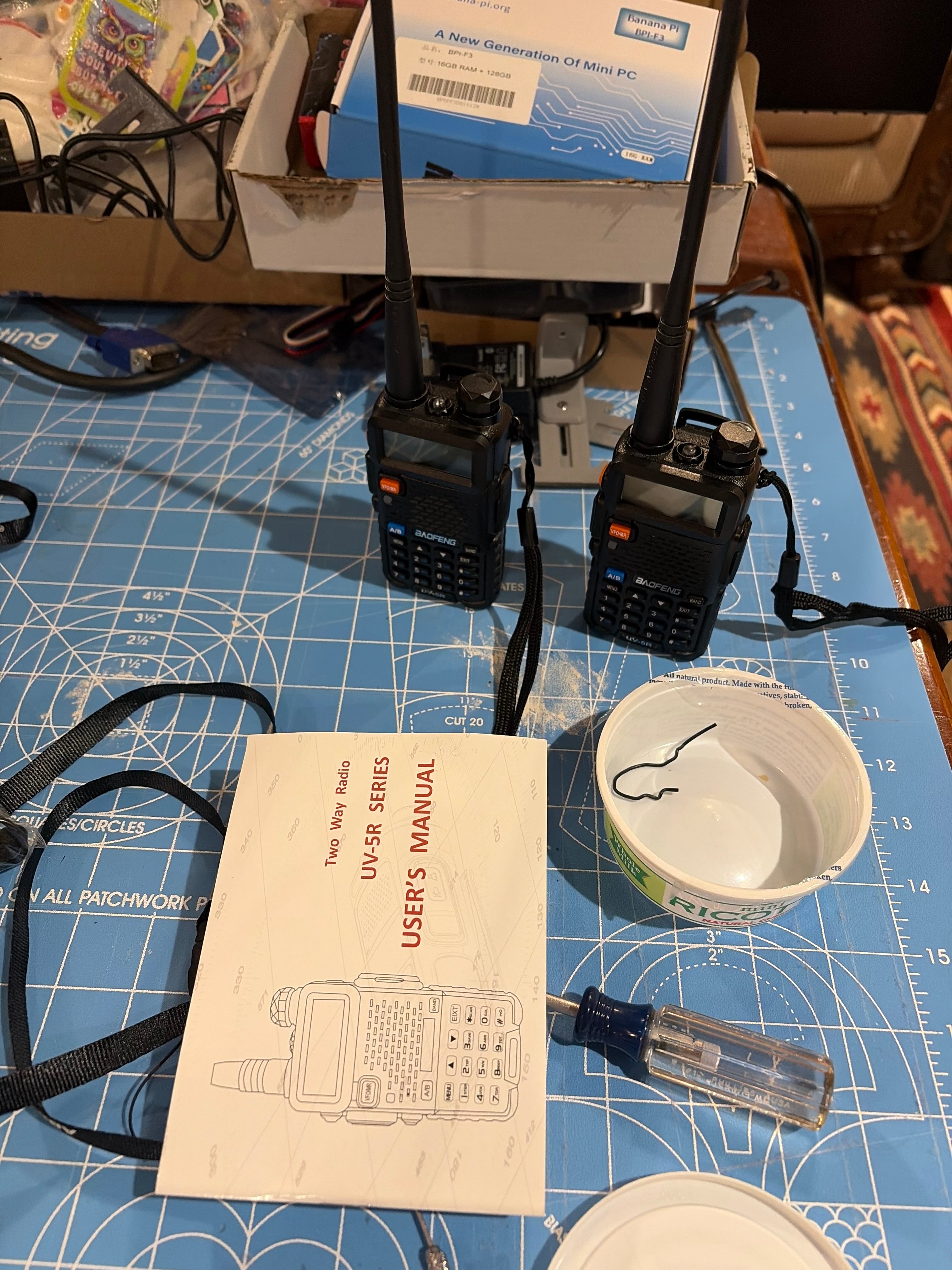
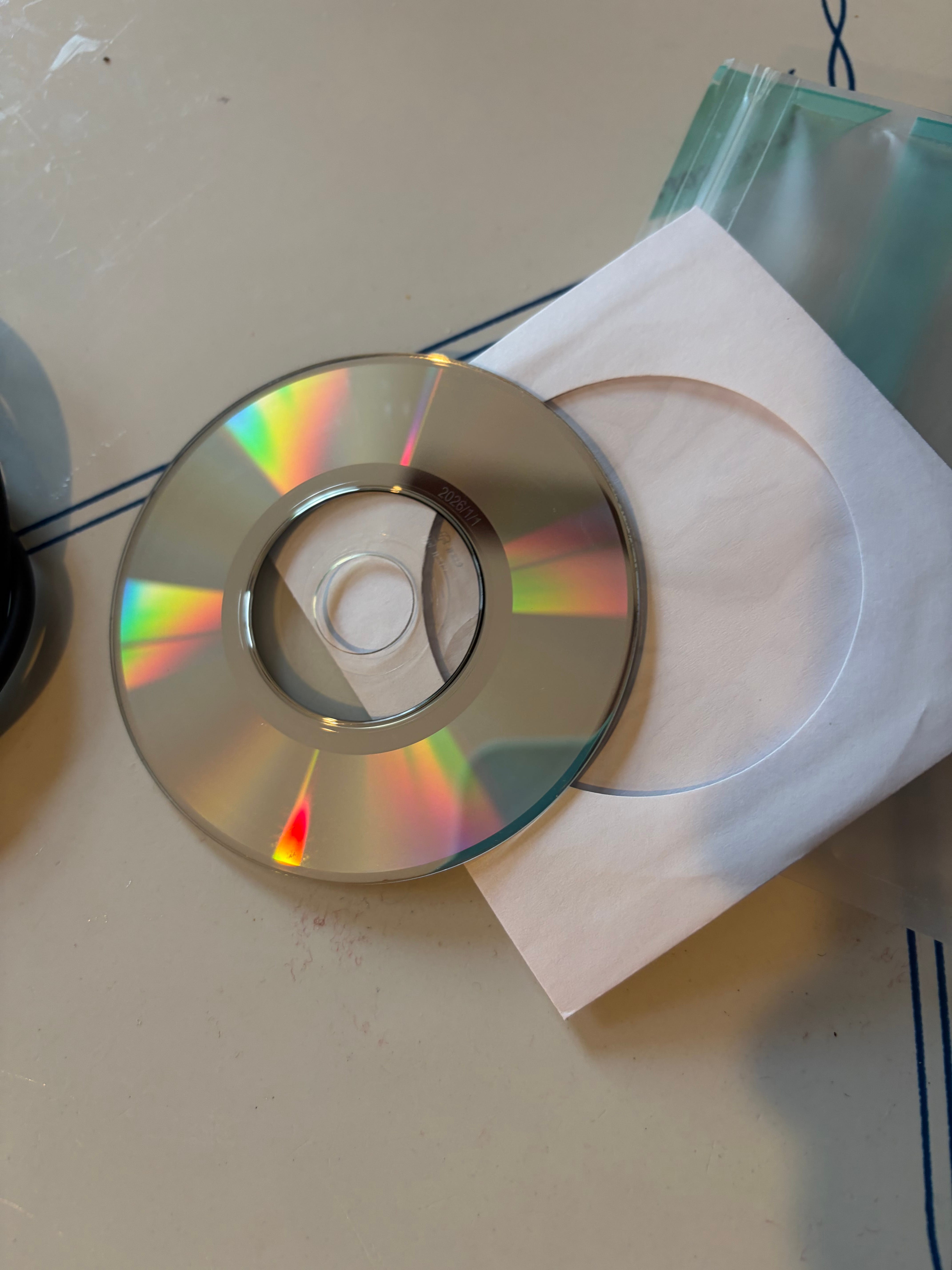
These are inexpensive (I paid $32 for two) and a bit inscrutable. They are kind of 🥔 radios, but for the price they seem worth it. There are even cheaper knockoffs like Pofung, which I think you can get for $10 or less each. Programming the Baofengs is extremely complicated via the keypad, but if you use a free program called CHIRP and a programming cable, you can use an intuitive spreadsheet-like program to load frequencies into your radio. I got a programming cable for $5, and it came with a mini CD which made me extremely happy. I’m not sure what’s on the CD though. Maybe some kind of PRC spyware?
As I do not have a HAM radio license (which sometimes surprises people - but being a HAM is all about following rules, which is something I do not enjoy), I had to figure out which frequencies I could use at least semi-legally. If you are a non-HAM and broadcast on HAM bands, the HAMs tend to lose their shit and will track you to the ends of the earth, because you did not follow the rules.
If you are not a HAM, I suggest looking at FRS (Family Radio Service), GMRS (General Mobile Radio Service - requires an inexpensive license), or MURS (Multi Use Radio Service). Each of these systems has a tiresome set of rules and regulations, and strictly speaking, the Baofengs do not comply with these rules and regulations. However, I have chosen to configure my radios to be as close to conformant with the rules as possible (frequencies, bandwidth, power limitations, etc.)
I chose to use MURS after listening to the 5 MURS frequencies for several days at my location and hearing no traffic. To use MURS legally, you have to buy a radio that only does MURS and is certified. I configured my Baofengs to use the exact same settings as a certified MURS radio, which is technically illegal for some reason.
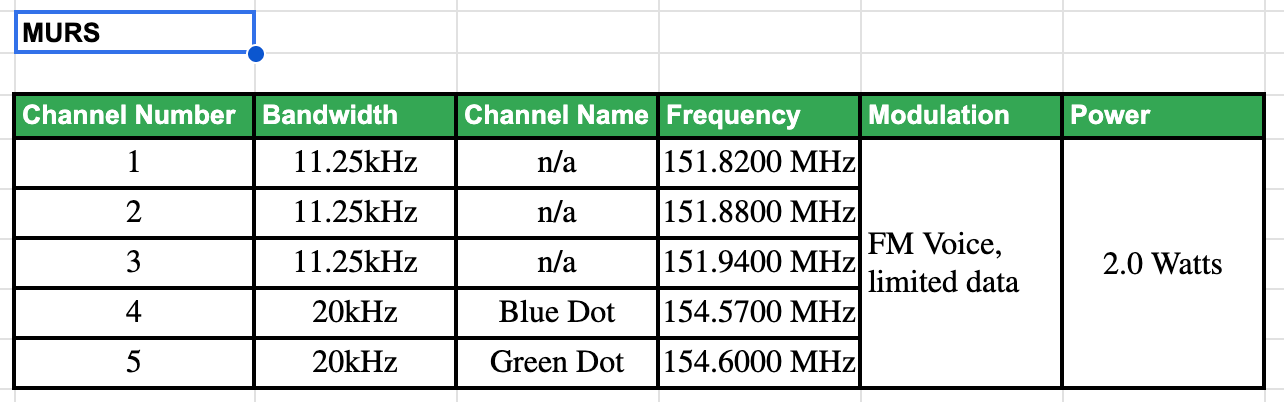
I used CHIRP to load these 5 frequencies into both radios, and we’ve been experimenting with them. This morning we had a range of about a quarter mile, but one radio had a stubby antenna on it and was located in a car (metal box) so conditions weren’t optimal. We will do more experimentation to see how far we can transmit as we learn more about the Baofengs. Man, Substack disappoints me sometimes. I can insert a freaking “Prediction Market” in a post and let people gamble, but I can’t insert a table.

Whatever, Substack.
One last thing I want to get off my chest. Every camera is a cop. Taking pictures of random people at an event and uploading the pictures to social media is just making Palantir’s job easier. If you must upload pictures of strangers to social media or cloud storage, blur faces, there’s plenty of tools to do this.
I’ve also been experimenting with another LoRa-based mesh network, Meshcore. Perhaps I’ll write up my experiences with that as well.